"Some people brought a blind man to Jesus, and they begged him to touch and heal the man. Jesus took the blind man by the hand and led him out of the village. Then, spitting on the man's eyes, he laid his hands on him and asked, 'Can you see anything now?' The man looked around. 'Yes,' he said. 'I see people but I can't see them very clearly. They look like trees walking around.' Then Jesus placed his hands over the man's eyes again. As the man stared intently, his sight was completely restored and he could see everything clearly." -- Mark 8:22-25
My husband Mike has been blind for 12 years and has had no sight in his left eye for over 40 years. A couple months ago, and without any medical intervention, he began seeing glimpses of things out of that eye. On Thursday I witnessed him read five numbers off an eye chart. And right there in the doctor's office while he was weeping and the doctor was doing everything she could to keep her own emotions in check, God dropped Mark 8 into my spirit. It has been an amazing faith journey for both of us and in a couple weeks, with the help of a new lens, Mike will be seeing people "like trees walking around!" Just one more touch from Jesus and his eyesight will be completely restored. Just remember God does instantaneous healings (like my healing from MS) and he also does gradual healings. All are to be celebrated.
Saturday, April 24, 2010

Friday, April 23, 2010
Wreck Dive - Journey back to World War II
I know I've been raving on diving like forever on this blog.
So this shall be the last one.
And the best one at that, well, base on my own experience anyway.
In this post, I am going to post about my first ever Wreck Dive.
Shipwreck - Mawali Wreck (a second world war sunken cargo ship located in Lembeh Strait).

Now I don't know about you. But I'm crazy about shipwreck. Something about a piece of lost history hidden beneath the sea that's waiting to be uncovered really excites me.

Ever since my first encounter with the movie Titanic, I've been fascinated by wrecks for as long as I was fascinated by birds and the bees.
Now I have compiled a documentary video on my journey down to the deep unknown. I have not done a documentary voice over video for a long time and if you're as curious about this dive as I was the first time, you would definitely enjoy this video.
Just a bit of a fact about the wreck, the giant is over 60 meters long and it's located down to 30m below sea level.

That's a long way down for any new diver. Visibility isn't great but the fun part of the dive is the penetration.
Yes you heard me.
PENETRATION.

In this video, you will see how me and a few other divers penetrating the wreck. Now not all wrecks can be penetrated, and usually it's dangerous to do so without proper guidance and research. Imagine the wreck crumples and falls on you.
There will be complete darkness. 30 meters below water. Confined in a sunken ship.
Oooohhh.... exciting.
Okay enough talking. Here's the video.
Here are some photos to share inside the wreck. I have to tell you this, it wasn't easy having a torch light on one hand and a camera recording in the other. But.. well.. the things I do for my readers.

oo... lobster. *shine at you*
It's easy to spot a few lion fish hidden in Mawali wreck, away from the current and in the darkness.


And because it wasn't easy to take photo inside complete darkness and confined area, this is perhaps the best shot I had in my entire photo album.

A shrimp.
The whole wreck is tilted in a way that the bottom is facing upward (if you look at the marker drawing white board again in the first photo), so there is plenty of surface area for artificial reef to grow and fester.

Camwhore with giant propeller
Some fish.

Corals.

The first dive master I met called this a boobie coral. Cause it's so soft and nice to touch, just like boobs. o.O

Rubbish.

tsk tsk... pick it up when you see on underwater will you?
While swimming along the bottom surface of the wreck, I came across this vast forestation of corals. It's incredibly beautiful.

I know the photo doesn't do it justice as to how vast this is. But believe me, it's like looking at a lavender field and you couldn't help but gasp at the sight.

And when you touch them (my dive guide showed me), they will retract their "tentacles" like so.

Looks like a pot of flower now.
Some of the other retractable corals.

So with this, I shall end my series of diving post.
I hope you have enjoyed my diving experience as much as I have spent diving and writing them.

I just can't wait for my next wreck dive. ^^
So this shall be the last one.
And the best one at that, well, base on my own experience anyway.
In this post, I am going to post about my first ever Wreck Dive.
Shipwreck - Mawali Wreck (a second world war sunken cargo ship located in Lembeh Strait).
Now I don't know about you. But I'm crazy about shipwreck. Something about a piece of lost history hidden beneath the sea that's waiting to be uncovered really excites me.
Ever since my first encounter with the movie Titanic, I've been fascinated by wrecks for as long as I was fascinated by birds and the bees.
Now I have compiled a documentary video on my journey down to the deep unknown. I have not done a documentary voice over video for a long time and if you're as curious about this dive as I was the first time, you would definitely enjoy this video.
Just a bit of a fact about the wreck, the giant is over 60 meters long and it's located down to 30m below sea level.
That's a long way down for any new diver. Visibility isn't great but the fun part of the dive is the penetration.
Yes you heard me.
PENETRATION.
In this video, you will see how me and a few other divers penetrating the wreck. Now not all wrecks can be penetrated, and usually it's dangerous to do so without proper guidance and research. Imagine the wreck crumples and falls on you.
There will be complete darkness. 30 meters below water. Confined in a sunken ship.
Oooohhh.... exciting.
Okay enough talking. Here's the video.
Here are some photos to share inside the wreck. I have to tell you this, it wasn't easy having a torch light on one hand and a camera recording in the other. But.. well.. the things I do for my readers.
oo... lobster. *shine at you*
It's easy to spot a few lion fish hidden in Mawali wreck, away from the current and in the darkness.
And because it wasn't easy to take photo inside complete darkness and confined area, this is perhaps the best shot I had in my entire photo album.
A shrimp.
The whole wreck is tilted in a way that the bottom is facing upward (if you look at the marker drawing white board again in the first photo), so there is plenty of surface area for artificial reef to grow and fester.
Camwhore with giant propeller
Some fish.
Corals.
The first dive master I met called this a boobie coral. Cause it's so soft and nice to touch, just like boobs. o.O
Rubbish.
tsk tsk... pick it up when you see on underwater will you?
While swimming along the bottom surface of the wreck, I came across this vast forestation of corals. It's incredibly beautiful.
I know the photo doesn't do it justice as to how vast this is. But believe me, it's like looking at a lavender field and you couldn't help but gasp at the sight.
And when you touch them (my dive guide showed me), they will retract their "tentacles" like so.
Looks like a pot of flower now.
Some of the other retractable corals.
So with this, I shall end my series of diving post.
I hope you have enjoyed my diving experience as much as I have spent diving and writing them.
I just can't wait for my next wreck dive. ^^
A history of psychology treasure trove
 If you're interested in the history of psychology, you'd better take a deep breath. A magnificent treasure trove of images, articles and interactive tests from the history of psychology has been placed online thanks to the Science Museum and the work of the British Psychological Society's curator of psychology Philip Loring.
The new online exhibition can be found on the Brought to Life section of the Science Museum website, under the new heading 'Mental Health and Illness'. One hundred and eighty-five artifacts, from arm restraints and bird cages to barbiturate bottles, have been carefully photographed and all are available open access for inspection and teaching. The artifacts are complemented by fascinating articles on mental institutions, nervous illnesses, trauma in war and peace, women and psychiatry, and psychiatric tests.
A particular highlight is three 'interactive' classic psychiatric tests: a picture completion task from the 1930s, an object sorting task from the 1940s, and the Lowenfeld Mosaics test from the 50's. In each case an animation allows you to explore the materials and you can actually watch patients with different diagnoses complete the tests and see how they would have been scored.
Most of the artifacts featured on the new site aren't on physical display in the museum because of space constraints. However, in 2010 and 2011, the BPS will be sponsoring a series of events in conjunction with the Science Museum's Dana Centre, which will allow members of the public to get up close to these and other objects from the Museum's psychology collection. Plans are also in the works to bring the 'melancholy insane woman' (see pic) to Glasgow for the BPS's Annual Conference in May 2011! Sign up to the Research Digest editor's Twitter feed for updates or email Philip.Loring@ScienceMuseum.org.uk for further info.
--
The image shows a life-sized wax head of a 'melancholy insane woman' dating from 1910-1950 [more information].
Face-to-face in a brain scanner
 Many neuro-imaging studies claim to have investigated what happens in the brain when people interact socially. To overcome the awkward fact that participants have to lie entombed in the bore of a large magnet, these studies have used various means to simulate a social interaction. This includes: having participants watch videos of social interactions; interact with an animated character; or play a game with a human opponent (usually computer controlled) supposedly located in another room. Such methods score marks for improvisation but arguably none of them fully capture the dynamic cut and thrust of a real face-to-face social interaction between two people. That's why Elizabeth Redcay and her colleagues have devised the first ever experimental set up that allows for live face-to-face (via video link) interaction whilst participants are prostrate inside a brain-imaging magnet.
Participants in this study watched a live video feed of the experimenter. The experimenter in turn had a display showing them a live feed of where the participant was looking. Experimenter and participant then engaged in a series of 'games' that required social interaction. For example, in one, the experimenter picked up various toys and the participant had to look in the direction of the appropriately coloured bucket to which the toy belonged. Compared with watching a recording of this same interaction, the live interaction itself triggered increased activation in a swathe of social-cognitive, attention-related and reward processing brain regions.
The second experiment involved the participant identifying which screen quadrant a mouse was hidden in. In the live 'joint attention' condition, the experimenter's gaze direction cued the mouse's location and only when both experimenter and participant looked at the correct quadrant did the mouse appear. Compared with a solo condition in which a house symbol cued the mouse location, the interactive joint attention condition triggered increased activation in the right superior temporal sulcus and right temporal parietal junction. The former brain region has previously been associated with processing socially relevant stimuli such as eye gaze and reaching, whereas the latter temporal-parietal region is associated with thinking about other people's thoughts.
Past research using simulations of social interaction has identified the dorso-medial prefrontal cortex as a key area involved in social engagement. The quietness of this region in the current study suggests it may have been the competitive or social judgement elements of previous paradigms, rather than social interaction per se, that led to its activation.
'Social interaction in the presence of a live person (compared to a visually identical recording) resulted in activation of multiple neural systems which may be critical to real-world social interactions but are missed in more constrained, offline experiments,' the researchers said.
Redcay's group said their new set-up would be ideal for studying the social difficulties associated with autistic spectrum disorders (ASD). Attempts to identify the neural bases of these difficulties have previously met with mixed success. 'A neuroimaging task that includes the complexity of dynamic, multi-modal social interactions may provide a more sensitive measure of the neural basis of social and communicative impairments in ASD,' the researchers said.
_________________________________
 Redcay E, Dodell-Feder D, Pearrow MJ, Mavros PL, Kleiner M, Gabrieli JD, & Saxe R (2010). Live face-to-face interaction during fMRI: a new tool for social cognitive neuroscience. NeuroImage, 50 (4), 1639-47 PMID: 20096792
Image courtesy of Elizabeth Redcay.
Wednesday, April 21, 2010
Don't start group discussions by sharing initial preferences
 When groups of people get together to make decisions, they often struggle to fulfil their potential. Part of the reason is that they tend to spend more time talking about information that everyone shares rather than learning fresh insights from each other. In a forthcoming paper, Andreas Mojzisch and Stefan Schulz-Hardt have uncovered a new reason groups so often make sub-optimal decisions. The researchers show that when a group of people begin a discussion by sharing their initial preferences, they subsequently devote less attention to the information brought to the table by each member, thus leading the group to fail to reach the optimal decision. The practical implications are clear - if you can, avoid beginning group decision-making sessions with the exchange of members' initial preferences.
Mojzisch and Schulz-Hardt began their investigation with a carefully controlled simulation of a real group discussion. Rather than exchanging ideas face-to-face, dozens of participants were presented with some selective written information about various job candidates and either told or not told about the initial preferences of other group members who'd received different information. Each participant then received the information that had been given to all the other group members.
Participants needed to consider the information available to the entire group if they were to identify the optimum candidate. Crucially, participants who began the session by hearing about other group members' initial candidate preferences were subsequently less successful at using the group's shared information to pick the optimum candidate. A memory test suggested this was because they'd paid less attention to the relevant information than had the participants who'd been kept in the dark about other members' initial candidate preferences.
A final study tested these effects in a real, face-to-face group decision-making situation. One hundred and eighty students participated in sixty three-person groups tasked with selecting the best among three job candidates. Each group member started off with a unique set of information about the three candidates and the optimum candidate selection could only be reached if group members shared with each other their unique information. Once again, groups were far less successful at sharing the necessary information, and therefore at reaching an optimal decision, if they began their session by sharing their initial candidate preferences. As before, the reason was that sharing initial preferences led group members to pay less attention to the relevant information during group discussion.
'The take-home-message of our study is simple,' Mojzisch told the Digest. 'Ninety per cent of group discussions start with the members exchanging their pre-discussion preferences. Our research shows that learning the other group members' preferences at the beginning of a group discussion has a negative effect on the quality of group decision-making.'
_________________________________
Andreas Mojzisch, & Stefan Schulz-Hardt (2010). Knowing others' preferences degrades the quality of group decisions. Journal of Personality and Social Psychology.PS. This study is due to be published in the Journal of Personality and Social Psychology in May. I will add a link to the abstract as soon as it's available.
PPS. The authors of the current study tipped off the Digest editor about their research findings. If you have some exciting peer-reviewed research in press, you too could tip off the Digest editor, for the chance to have your findings popularised on one of the world's leading psychology blogs. Email: christianjarrett[@]gmail.com Thanks!
Veggie-based entree ideas perfect for spring-- and the whole family!

Tonight I am making a baked mac & cheese, using whole wheat penne and spinach. If it’s a winner, I’ll post the recipe. In the meantime, for those who have asked for more veggie-based, family-friendly entrees these are some of my favorites for springtime:
Citrus-y Black Beans: while I usually make these beans as a side (with my decadent chicken enchiladas), they can also make a colorful veggie-based entrée. Think of it as a family taco night, minus the meat and fried taco shells. Put bowls of various toppings out for the kids (and adults) and let everyone concoct their own bowl of rice and beans (pictured above). Topping ideas: yellow rice + the citrus-y black beans + avocado chunks + organic corn + chunks of tomato + diced bell pepper + sour cream + shredded cheddar + salsa + baked tortilla chips.
Greens & Cheese Pie: I love, love, love this entrée. This just might be what I whip up for my cook day next Wednesday.
Homemade Pesto: is great in so many ways: on pasta, drizzled over grilled veggies, mixed into a quinoa salad. In addition to this nut + basil one that I like to make a big batch of and freeze, I made a nutritious and delicious Broccoli/Hazelnut Pesto last week. Stay tuned for that recipe.
Tuesday, April 20, 2010
Muck Diving - The Deadly Flower Urchin
I learnt about Muck Diving when I was in Lembeh, a term created for dives done in muddy or mucky sea environment.
Most of the time you find only sand, or mud, along with dead corals and more sand when you go for a muck diving.

Technically speaking, muck diving is a rather boring dive, especially for amateur divers. And can be the worst form of dive to take your first ever dive experience (discovery scuba - for people who have yet to get your first diving license)
Before you think it's complete lunacy for me to fly cross the sea just to land myself in some secluded god forsaken place to see sand underwater, keep in mind that muck diving does has its own attractiveness.
Basically, the common motto of muck dive: Not all is what it seems.

Do you see anything? Almost making it out the shadow outlining the sandy bottom?
What thing is that weirdly shaped camouflaged thing?
Look closer.

Muck diving is like going on a treasure hunt with a tank and mask, except you don't know what you're looking for.

There are abundance of juvenile creatures and exotic organisms living among the hiddens. It's almost a thrill when you're able to spot one.

Most muck diving are done in South East Asia because of the rich marine lives on offer, so if you're an avid diver and you live here, it's insane not to do at least a muck dive trip in your life.
Some of the common living things are colorful nudibranch (a.k.a. sea slugs) or sometimes, colorless shrimps.

Which are quite easy to spot when you scout around the singled-out coral on the sea bed.

Well, almost quite easy.
A coral such as this is like a oasis in a dessert - they're not very common but when there's one, it's a sanctuary for all. So usually there are more than one living things hiding amongst it.


clown fish family
The other reason why muck diving can appear very dull is because the marine lives in the muck are able to disguise themselves very well.
Almost too well for some.

From far you might just think that this is a rope, stranded sea grass or worm at most.
But if you know your fish well, you know it's actually a bloody worm-like fish!

It looks like a rope, acts like a rope, but it's not a rope.
In this case, assuming we're all newbies, following a local guide is the best way to spot unusual underwater creatures.

Looks like a common coral or a rock?
NO!
Meet... the decorator crab.

Here's a video of how camouflaged a fish can be at the sandy bottom of the sea.
Click on the video and look closely in the beginning 2 seconds if you can spot anything at all.
Poor bugger was being chased by me all the way.

Until it lifted its spike in the end feeling threatened before I left it alone.
Scary!

Among other fish, I also stumbled upon a few more odd ones.

Colorful with a really long spike on its head. Reason why this is the closest photo I have of it.

some moth looking fish.

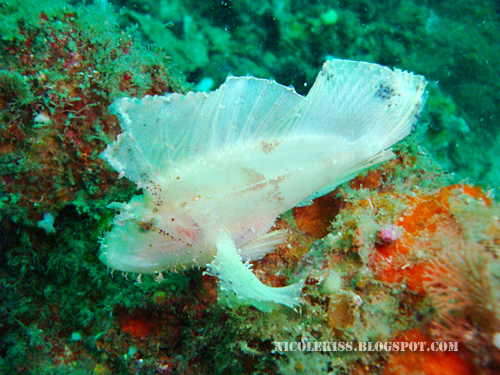
a common fish to spot during muck dives - waspfish!
Personally I like this fish a lot. Reminds me of leaffish. (click here for leaffish photo)

Not all unusual and exotic are marine lives though. Corals can be pretty quirky here too.

Looks like a bunch of condom balloons.
I always had a penchant of touching things around me (bad habit of mine last time, note: past tense :p). But for some reasons I wasn't too keen in touching that one.
Oh, about that. Here's a little tale of mine that almost took my life during this dive. *drama*
You know corals are fun to touch as long as you know you don't do harm to it (for critics: corals don't die after you touch them, they only die when you pick them up from the ocean and they harden and die, or when you pluck them from their habitat, they might die; but the common corals WON'T die if you just gently brush your finger along it just to feel its texture).
Though common knowledge is, don't touch what you're not familiar with!
So I was smart when I come across a coral-like urchin on the sea bed.

The warning statement "DO NOT TOUCH IT" flashed across my mind like a neon banner on a Casino in Las Vegas.
Like duh! Who would touch such a dangerous looking thing?! That.. that THING looks like it has a thousand needles protruding out in all possible direction, ready to penetrate and injure anyone that comes pass it.

I thought I was smart to just leave it alone and not get too close to it.
But what would you think when you come across something like this?

I was feeling all proud of myself being cautious and all when I came upon this... this.. pretty "pot of flowers"-looking coral? Which I later found out was a Flower Urchin.
Sweet name, yes?
NO!!
So basically what happened was, I felt attracted to the pretty little thing that I swam up to it and was observing it up close, tempting my finger to touch its pretty little "petal"... closing in... closing in...
When my dive master appeared out of no where. Snap my hand so hard I was thrown back in water and looked dead to me in the eye...
and did one signal no diver would ever want to see.
'He swept his hand horizontally across his neck.' - indicating.... DEATH.
(or out of breath if you're talking about oxygen left in your tank)
When I returned to the lodge after the dive. I immediately sat down and looked up flower urchin in the dive books most dive lodge have.
This was what I found - the Flower Urchin is "extremely dangerous", it can be very deadly despite it attractive outlook.
Multiple times MORE DANGEROUS than the long-spined urchin I saw and avoided earlier.

The pretty petals on the flower urchin are actually venomous pincers able to cause paralysis or even death!
According to this page about Flower Urchin, if you don't die from the sting, "The sting results in intense radiating pain, prickling or numbness, abnormally low blood pressure, respiratory distress, and muscular paralysis all of which lasting anything up to 6 hours."
So that means you would also drown from the sting, which could also result in death.
*Gulp*
Right. From this day on, I will never ever ever ever... touch a coral ever again!
*touch no evil*
Well, maybe just the corals Nemo swims in. :p
(nah just kidding hehe)
Most of the time you find only sand, or mud, along with dead corals and more sand when you go for a muck diving.
Technically speaking, muck diving is a rather boring dive, especially for amateur divers. And can be the worst form of dive to take your first ever dive experience (discovery scuba - for people who have yet to get your first diving license)
Before you think it's complete lunacy for me to fly cross the sea just to land myself in some secluded god forsaken place to see sand underwater, keep in mind that muck diving does has its own attractiveness.
Basically, the common motto of muck dive: Not all is what it seems.
Do you see anything? Almost making it out the shadow outlining the sandy bottom?
What thing is that weirdly shaped camouflaged thing?
Look closer.
Muck diving is like going on a treasure hunt with a tank and mask, except you don't know what you're looking for.
There are abundance of juvenile creatures and exotic organisms living among the hiddens. It's almost a thrill when you're able to spot one.
Most muck diving are done in South East Asia because of the rich marine lives on offer, so if you're an avid diver and you live here, it's insane not to do at least a muck dive trip in your life.
Some of the common living things are colorful nudibranch (a.k.a. sea slugs) or sometimes, colorless shrimps.
Which are quite easy to spot when you scout around the singled-out coral on the sea bed.
Well, almost quite easy.
A coral such as this is like a oasis in a dessert - they're not very common but when there's one, it's a sanctuary for all. So usually there are more than one living things hiding amongst it.
clown fish family
The other reason why muck diving can appear very dull is because the marine lives in the muck are able to disguise themselves very well.
Almost too well for some.
From far you might just think that this is a rope, stranded sea grass or worm at most.
But if you know your fish well, you know it's actually a bloody worm-like fish!
It looks like a rope, acts like a rope, but it's not a rope.
In this case, assuming we're all newbies, following a local guide is the best way to spot unusual underwater creatures.
Looks like a common coral or a rock?
NO!
Meet... the decorator crab.
Here's a video of how camouflaged a fish can be at the sandy bottom of the sea.
Click on the video and look closely in the beginning 2 seconds if you can spot anything at all.
Poor bugger was being chased by me all the way.
Until it lifted its spike in the end feeling threatened before I left it alone.
Scary!
Among other fish, I also stumbled upon a few more odd ones.
Colorful with a really long spike on its head. Reason why this is the closest photo I have of it.
some moth looking fish.
a common fish to spot during muck dives - waspfish!
Personally I like this fish a lot. Reminds me of leaffish. (click here for leaffish photo)
Not all unusual and exotic are marine lives though. Corals can be pretty quirky here too.
Looks like a bunch of condom balloons.
I always had a penchant of touching things around me (bad habit of mine last time, note: past tense :p). But for some reasons I wasn't too keen in touching that one.
Oh, about that. Here's a little tale of mine that almost took my life during this dive. *drama*
You know corals are fun to touch as long as you know you don't do harm to it (for critics: corals don't die after you touch them, they only die when you pick them up from the ocean and they harden and die, or when you pluck them from their habitat, they might die; but the common corals WON'T die if you just gently brush your finger along it just to feel its texture).
Though common knowledge is, don't touch what you're not familiar with!
So I was smart when I come across a coral-like urchin on the sea bed.
The warning statement "DO NOT TOUCH IT" flashed across my mind like a neon banner on a Casino in Las Vegas.
Like duh! Who would touch such a dangerous looking thing?! That.. that THING looks like it has a thousand needles protruding out in all possible direction, ready to penetrate and injure anyone that comes pass it.
I thought I was smart to just leave it alone and not get too close to it.
But what would you think when you come across something like this?
I was feeling all proud of myself being cautious and all when I came upon this... this.. pretty "pot of flowers"-looking coral? Which I later found out was a Flower Urchin.
Sweet name, yes?
NO!!
So basically what happened was, I felt attracted to the pretty little thing that I swam up to it and was observing it up close, tempting my finger to touch its pretty little "petal"... closing in... closing in...
When my dive master appeared out of no where. Snap my hand so hard I was thrown back in water and looked dead to me in the eye...
and did one signal no diver would ever want to see.
'He swept his hand horizontally across his neck.' - indicating.... DEATH.
(or out of breath if you're talking about oxygen left in your tank)
When I returned to the lodge after the dive. I immediately sat down and looked up flower urchin in the dive books most dive lodge have.
This was what I found - the Flower Urchin is "extremely dangerous", it can be very deadly despite it attractive outlook.
Multiple times MORE DANGEROUS than the long-spined urchin I saw and avoided earlier.
The pretty petals on the flower urchin are actually venomous pincers able to cause paralysis or even death!
According to this page about Flower Urchin, if you don't die from the sting, "The sting results in intense radiating pain, prickling or numbness, abnormally low blood pressure, respiratory distress, and muscular paralysis all of which lasting anything up to 6 hours."
So that means you would also drown from the sting, which could also result in death.
*Gulp*
Right. From this day on, I will never ever ever ever... touch a coral ever again!
*touch no evil*
Well, maybe just the corals Nemo swims in. :p
(nah just kidding hehe)
Subscribe to:
Posts (Atom)