Geoff Winston has been listening to four CDs from Porter Records.
Porter Records calls itself the "home of an eclectic roster of talented musicians". The word "eclectic" is pure understatement - yes, Americans do understatement - but it is also a commendation. Based in the liberal enclave of Madison, Wisconsin, Porter Records is the brainchild of Luke Mosling, who has a passion for music of quality, with a healthy disregard for the boundaries of genre and an affection for the experimental.
The catalogue ranges across avant-jazz, jazz-rock, improv, rock with a Zappa/Beefheart inclinations, new music and fringe hip-hop, and includes both new releases and unearthed gems from the 70s and 80s. If you have a catholic and enquiring approach to your music, this label could become a regular port of call.
Porter's website has decent sound clips, including some complete tracks, for virtually every album, which lets you dip in and get a good idea of whether a particular release is for you, and there are a good number that are issued on vinyl, too.
The four CDs we've been listening to cut across the boundaries.
- An immaculately produced reissue of Heikki Sarmanto's 1972 big-band album, 'Everything Is It'.(the latest release)
- Misled Children's 'Peoples Market', a lo-fi jazzy hip-hop groove
- 'Further Secret Origins', a solo album from boundary-pushing bassonist Katherine Young
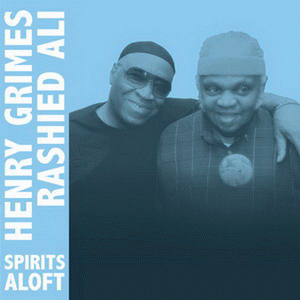
- 'Spirits Aloft', a 2009 live date from two true masters, Henry Grimes and Rashied Ali, which, sadly, would be their last collaboration.
To give some extra context, Taylor Bo Hynum and Jessica Pavone, seen last week in London with Thirteenth Assembly and reviwed HERE, have each recorded with Porter.
Porter Records calls itself the "home of an eclectic roster of talented musicians". The word "eclectic" is pure understatement - yes, Americans do understatement - but it is also a commendation. Based in the liberal enclave of Madison, Wisconsin, Porter Records is the brainchild of Luke Mosling, who has a passion for music of quality, with a healthy disregard for the boundaries of genre and an affection for the experimental.
The catalogue ranges across avant-jazz, jazz-rock, improv, rock with a Zappa/Beefheart inclinations, new music and fringe hip-hop, and includes both new releases and unearthed gems from the 70s and 80s. If you have a catholic and enquiring approach to your music, this label could become a regular port of call.
Porter's website has decent sound clips, including some complete tracks, for virtually every album, which lets you dip in and get a good idea of whether a particular release is for you, and there are a good number that are issued on vinyl, too.
The four CDs we've been listening to cut across the boundaries.
- An immaculately produced reissue of Heikki Sarmanto's 1972 big-band album, 'Everything Is It'.(the latest release)
- Misled Children's 'Peoples Market', a lo-fi jazzy hip-hop groove
- 'Further Secret Origins', a solo album from boundary-pushing bassonist Katherine Young
- 'Spirits Aloft', a 2009 live date from two true masters, Henry Grimes and Rashied Ali, which, sadly, would be their last collaboration.
To give some extra context, Taylor Bo Hynum and Jessica Pavone, seen last week in London with Thirteenth Assembly and reviwed HERE, have each recorded with Porter.

Heikki Sarmanto Big Band: 'Everything Is It' (2011)
'Everything Is It' is a dynamite blast of brassy jazz, mashing it up with some early 1970s concept jazz-rock in a suite of four movements. Recorded in Helsinki in 1972, it is the fourth album by Heikki Sarmanto, the first Finnish recipient of a Berklee scholarship, and corrals the talents of some exceptional musical compatriots in classic big band arrangements, scintillatingly executed on a recording which captures all the energy of sessions completed in a mere two days. To get a hint of the flavour, imagine the tightest of section work, delivered with the dynamic aplomb of Kenton or Gill Evans.
A close relation would be the Ivan Jullien/Eddy Louiss big band recording of 'Porgy and Bess' of the same year. The brass is mellifluous and muscular and there are superb solos on flugelhorn, saxes and flute, as well as Sarmanto's on Fender- Rhodes, placing it in that 70s jazz-rock zone, and a drum solo duet in true stereo! The suite kicks off with a riffy statement and the extraordinary soaring vocals of opera singer Taru Valjakka, somewhere between early Norma Winstone and Christian Vander. My only reservations are with the lyrics - a cosmic myth construct, albeit, in short measure - which casts the suite as 'of its time'. That shouldn't take anything away from the tremendous, high energy playing which in the suite and the two additional compositions on the CD achieves its own timeless quality.
Henry Grimes and Rashied Ali: 'Spirits Aloft' (2010)
'Spirits Aloft', recorded live at Rutgers in February 2009 is pure poetry. In the 60s Grimes made his mark recording with Rollins and Ayler, and Ali with Coltrane, amongst many others in the vanguard, so this reunion draws on a significant heritage, and is one of the five duo concerts they played between 2007 and 2009. Those who were lucky enough to see Grimes recently with Marc Ribot will know what a majestic, inspired and empathetic bass player he is. With drummer Rashied Ali, onstage, there was telepathy. From the tight thuds and taps underpinning Grimes's opening flourishes on violin to the richly stippled responses as Grimes turned up the heat on his bass improvisations, Ali kept the momentum flowing. As Grimes charted a unique, resonant path, Ali was the perfect foil and companion, throwing in the softest of touches and rhythms before laying down his own solo sequence of echoes, accents and rolls. Both masters had that supreme confidence to jointly direct their dialogue and take the audience with them. Grimes said in his moving tribute at Ali's memorial celebration later in 2009, quoted in the sleeve notes, "Rashied knew how to cause music to have life and give life." The same can be said for Grimes, and this spirit is the essence of this wonderful recording, every nuance so expertly captured that the listener gets as close as is possible to being there on the night.

Misled Children: 'Peoples Market' (2008)
This set of 14 lo-fi, retro-facing, jazz-soul-funk-hiphop instrumental sketches fashioned by Clutchy Hopkins has an infectious and deliberately 'home-made' quality. Intended to come across as something of an oddity, it is recorded without samples on 'live' instruments by the anonymous Misled Children, and tracks are identified only by their number in the running order. Tracks can end somewhat abruptly after building up catchy hypnotic grooves. On '6' the melody and bass lines are pared down to a minimal 1 min 18 secs, which could equally have been extended to 18 mins 1 sec! The hook of '3' has the feel of a Talking Heads backing track circa-1977.
A faint 70s urban wah-wah soul feel permeates '4' behind a strong bass and drums pulse. An acoustic Spanish guitar melody rides in over a relaxed percussion backdrop on '5'. There is a suggestion of 'Light My Fire' with a dishy jazz-funk flute riff on '11', and Moondog-style flute turns in to a low-level chunky groove with a hint of 'Riders on the Storm' on'12'. There is even a hint of Curtis Mayfield on '13' - the vocals are implied 'in absentia'. Other tracks are infused with a warm Farfisa glow. With so much indirect referencing in the nostalgic, melancholic vibe, 'Peoples Market' works with an irresistible charm, and although it is not Wigan Casino, you can dance to it!

Katherine Young: 'Further Secret Origins' (2009)
This cryptically intense solo exploration of the bassoon commences with a foghorn statement and dissolves into oblique voicings, escapes of air through fine fissures, the softest of clatterings of the keys and the crackle of old vinyl. Young delights in the discovery of sounds within the instruments similar to the pioneering approaches that Mats Gustafsson and John Butcher apply to woodwind and brass, and returns to expand the vibrant, raw articulations to the accompaniment of a steady background beat. Occasionally, multi-tracking is used to create an layered, internal dialogue, notably on 'Some People Say She Doesn't Exist', and the briefest of effects are employed to add perspective. Liquid voicings melt into hoarse vibrato and Young finds accidental tones which she stretches and relocates at a nearby pitch. A long spell of hovering double-reed work becomes a voyage across a hot, dry landscape with ancient, aboriginal atmosphere. 'Orbis Tertius' is based on a single extended note pushed out with harmonics and whistlings before ending the album on a clear crescendo. A completely absorbing CD which, like other Porter recordings, so well produced that it brings the listener close to the musician, as though at a recital.
porterrecords.com
UPDATE: London-based musician Zenlo has drawn our attention to his 2009 release on Porter Records Skelethal Antics


